
Second Sunday of Christmas: Jeremiah 31:7-14; Ephesians 1:3-6,15-19a; Matthew 2:13-15,19-23; Matthew 2:1-12; Psalm 84:1-8
For today, preachers are given three choices for the gospel, and I have chosen to put together the two readings from Matthew. It gives us almost the whole story around Herod and the birth of Jesus. There is a lot of movement, and dreams are important.
We start with the wise men, who set off following a star, which told them that the king of the Jews had been born. They ask for directions in Jerusalem, and are sent off to Bethlehem. But Herod asks them to return, to tell him where they found this child. They find Jesus, and “paid him homage“, and provided their gifts. But they are warned in a dream, so avoid Jerusalem on their way home.
Like the Magi, Joseph has a dream which tells him to take his wife and child and high tail it to Egypt, because Herod is about to search for Jesus. The warning protects Jesus from what happens next, the massacre of the children of Bethlehem. It is skipped in our readings for today because it is read on Holy Innocents, December 28. Herod, discovering that the Wise Men had not returned, decided to kill all children in Bethlehem and the area around it under the age of two.
Matthew doesn’t tell us how long Joseph, Mary and Jesus stay in Egypt: it is just until Herod died. While Jesus would not have remembered the first journey, he might well remember life in Egypt. Then another dream instructs Joseph to return. But Joseph, realizing that Herod’s son was ruling, does not return home, but to Nazareth: while Luke’s birth narrative has Mary and Joseph in Nazareth before Jesus’ birth, for Matthew, it’s a relocation. So the Magi take a journey to avoid a tyrant, Joseph flees and lives as a refugee for an uncertain amount of time, and even when the family returns to Israel, they settle outside the area controlled by Herod’s son.
Much of this story is familiar: people have fled violence and oppression for centuries, and Matthew reminds us of the fear and violence from rulers in Roman Palestine. We tend to imagine past worlds as static, but we are reminded that people then as now sought safety by traveling.
What were the stories that Mary and Joseph told a young Jesus about their flight to Egypt? What did Jesus remember when they returned? Was Jesus aware that his parents had chosen a new place to live based on fear of the ruler? How did his experience of the precarity of existence under Roman power shape his ministry? How did it shape people’s response to him?
The Christian narrative tells us that the desire for a King to rescue the Jews from Roman power was an illusion. Jesus tells us he is creating a different kind of kingdom. But throughout the gospels it is clear that there is a desire for a change in the earthly kingdom. The Jews of first century Palestine were vulnerable to the powers of the conquerors.
When Jesus tells us to “love your neighbor as yourself“, he is emphasizing the importance of solidarity. Although he does not connect it directly to Roman violence, it is a practice of resistance.
Many people, in all periods of history, were vulnerable to violence by their rulers. We live in a world where many people, like the Magi, and Joseph, Mary, and Jesus, have had to travel new routes because the familiar one is not safe for them. As we love all our neighbors, may it shape for us the solidarity that comes from seeing our own safety and that of our neighbors as connected.
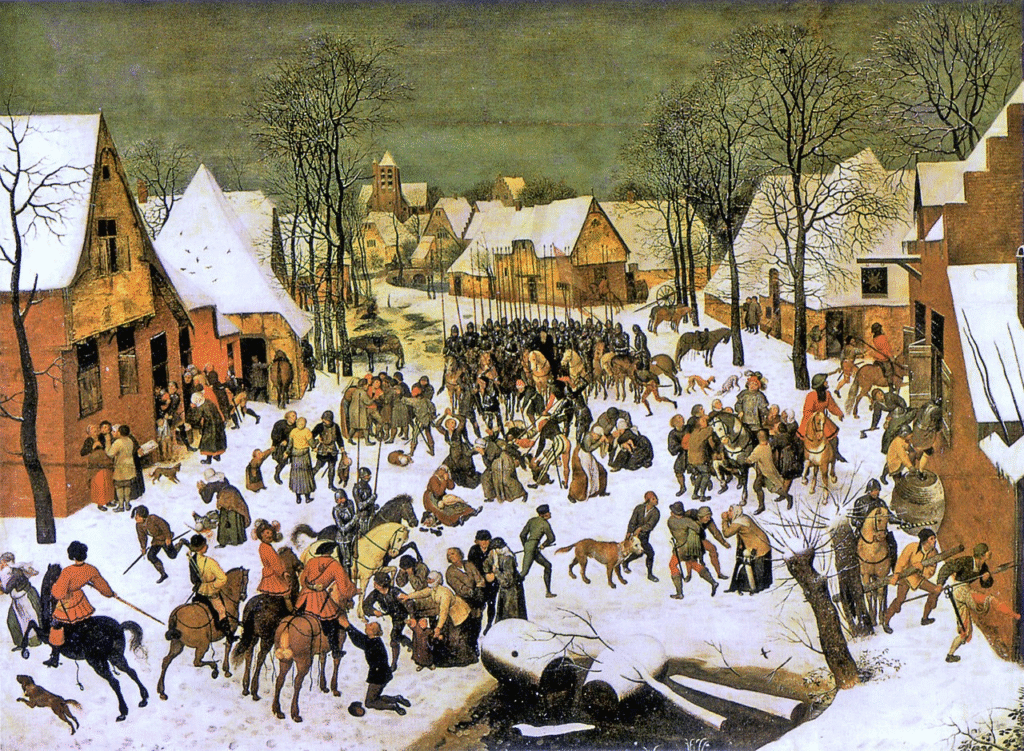
Pieter Brueghel the younger, The Massacre of the Innocents, Kunsthistorisches Museum, Vienna (Public Domain)
Leave a Reply