
Second Sunday of Advent, December 7, 2025: Isaiah 11:1-10; Romans 15:4-13; Matthew 3:1-12; Psalm 72:1-7, 18-19
You’ve got to hand it to him, John the Baptist was quite a sight. He appears in the wilderness, telling everyone to repent because “the kingdom of heaven has come near”. I’ve always wondered who exactly in the wilderness John is talking to, but he’s clearly got an audience. That in spite of the fact that he was wearing camel’s hair clothing and a leather belt, and “his food was locusts and wild honey”.
Anyone who has spent time in the wilderness, even the relatively tame wilderness of our national parks, knows it is easy to get lost, to get disoriented. You think you are following a trail, and then you wonder if you missed a turn. I once had a six mile hike turn into a twelve mile hike because we kept losing the way.
But there are also moments of magic in the wilderness, times when you feel at one with the universe, or have a glimpse of the connections between all creatures, or feel the presence of God. There is something about being out of our comfort zones that opens us to experiencing the world in new ways. So it is not surprising that John comes out of the wilderness with his call to repent, or that Isaiah tells the people of Israel to listen to “the voice of one crying out in the wilderness”.
In our reading from Isaiah today, we hear more about the promised time of the Lord. The Son of Man will be a shoot “from the stump of Jesse”: even if you thought the tree was dead it is still sending out shoots. He will not be like the rest of us: He shall not judge by what his eyes see, or decide by what his ears hear; but with righteousness he shall judge the poor, and decide with equity for the meek of the earth. Isaiah reminds us that we do not see the way the Lord does, and so the poor will have justice, the meek equity. Implicitly, Isaiah reminds us that this is not generally the case.
Isaiah’s prophecy includes his beautiful description of the peaceable kingdom, where The wolf shall live with the lamb, the leopard shall lie down with the kid,
the calf and the lion and the fatling together, and a little child shall lead them.
The cow and the bear shall graze, their young shall lie down together; and the lion shall eat straw like the ox.
In the early 19th century, the Quaker painter Edward Hicks painted hundreds of versions of this scene. In the one below, Hicks portrayed an imagined scene of peaceful exchange between William Penn and the Indigenous people of Pennsylvania. He was, then, imagining America as the peaceable kingdom. We know it was not true, and that less than 30 years after this was painted the US was mired in Civil War.
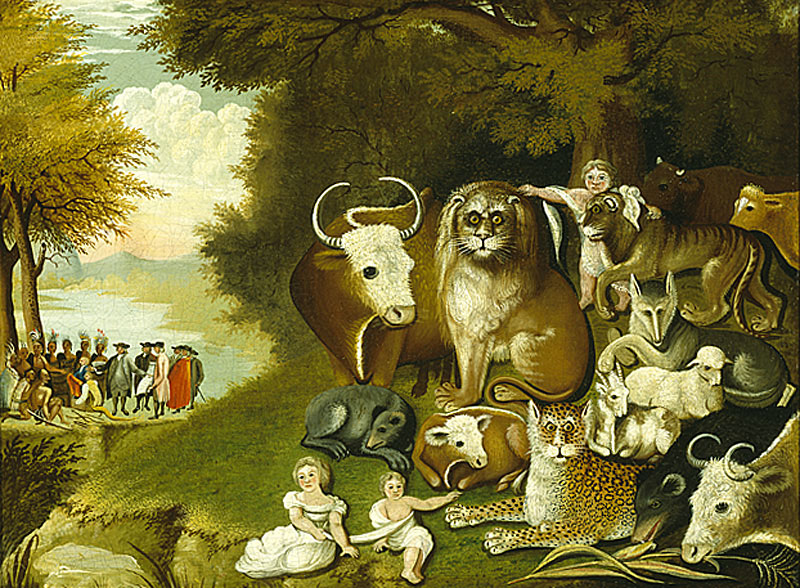
Pennsylvania Academic of Fine Arts, https://www.pafa.org/museum/collection/item/peaceable-kingdom, c. 1833
We do not need to look far to know that the peaceable kingdom promised by Isaiah is not present here on earth. There is violence in our country, and wars in Sudan, Gaza, Ukraine and many other areas. John calls us to repent and to bear good fruit. Our challenge in Advent is to bear good fruit, to create places where we can make Isaiah’s promise a reality.
Leave a Reply